Appearance
Demo Experience
Overview
At the demo booth, attendees will interact with a live FoveaCam Duo system performing real-time foveated stereo depth sensing. The demonstration is designed to let visitors experience each stage of the pipeline — from wide-angle scene understanding to MEMS-steered high-resolution depth — on real scenes in front of the booth.
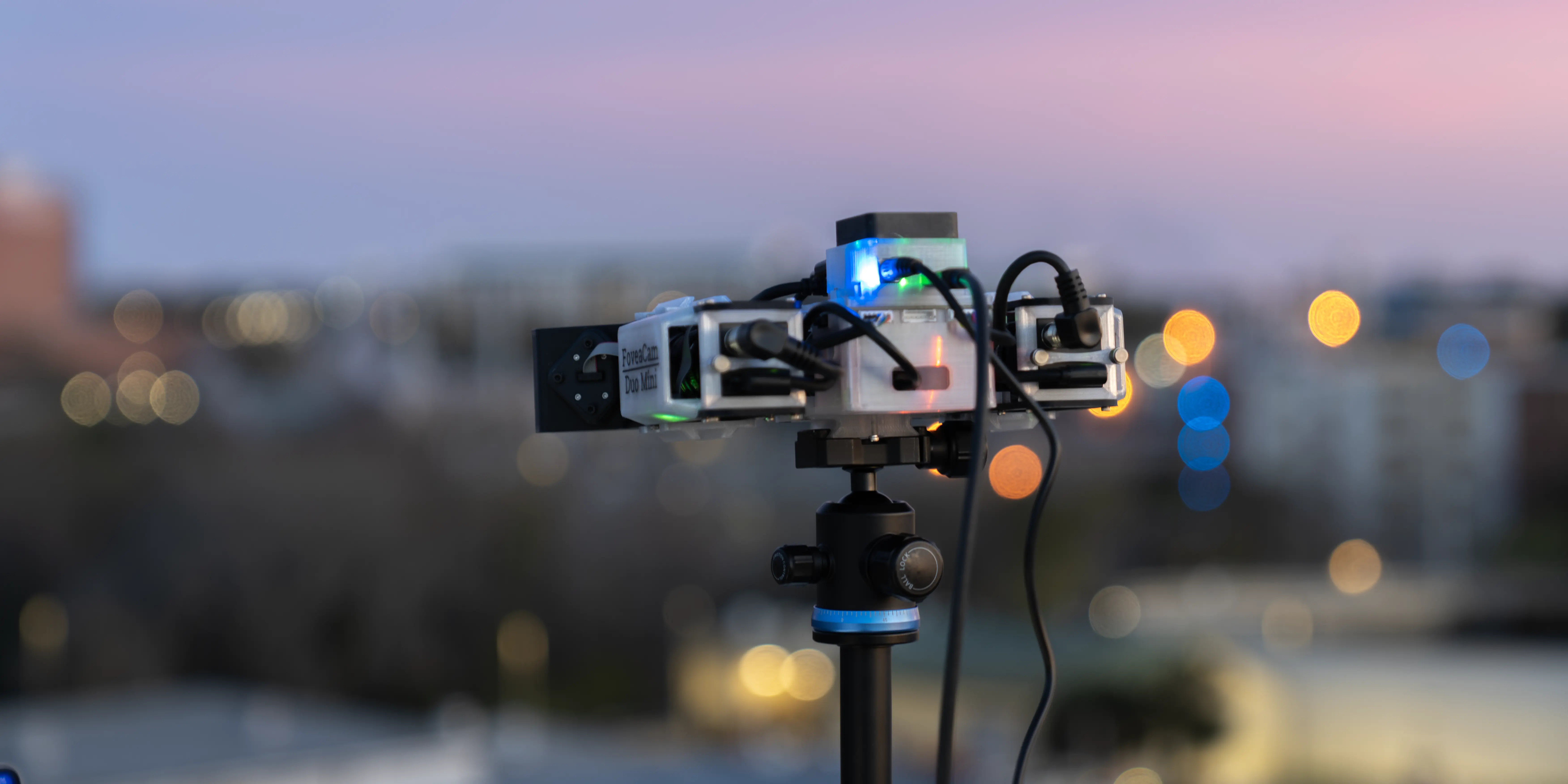
FoveaCam Duo Capturing Data in the Field
Live System Demonstration
The core of the demo is the FoveaCam Duo hardware running our custom GUI application. Attendees will be able to:
- View the live wide-angle stream covering the full
field of regard, providing a global overview of the scene. - Select a target region by clicking on the wide-angle view or by placing an object in front of the camera. The MEMS mirrors steer the left and right telephoto cameras to converge on the selected region in sub-millisecond time.
- Observe the foveated stereo pair in real time, showing the
angular resolution boost and the resulting high-resolution depth patch overlaid on the wide-angle context. - Adjust stereo parameters such as disparity search range and sub-pixel refinement level, and see their effect on the live depth map.
The GUI displays all three camera streams (wide-angle, left fovea, right fovea), the rectified stereo pair, the computed disparity map, and the metric depth output simultaneously.
Calibration Walkthrough
Alongside the live demonstration, we will showcase the full three-stage calibration pipeline:
- Intrinsic calibration — The wide-angle camera's checkerboard calibration, showing the recovered camera matrix
and the pixel-to-angle mapping. - Extrinsic calibration — The pan-tilt sweep with ArUco markers, illustrating how MEMS voltages
are mapped to pointing angles via 3rd-order polynomial regression. - Homography rectification — Before-and-after visualization of foveated image rectification, demonstrating how the angle-dependent homography
warps distorted foveated images into a virtual parallel-stereo pinhole model.
Attendees can examine the calibration hardware (pan-tilt platform, ArUco marker array) and step through the calibration interface.
Equipment and Space Requirements
Provided by authors:
| Item | Details |
|---|---|
| Camera system | FoveaCam Duo unit on tripod |
| Compute | Laptop for real-time stereo streaming and interaction |
| Display | External monitor for the GUI application |
| Calibration hardware | Pan-tilt platform; linear rail; printed markers |
Needed from the conference venue:
| Item | Details |
|---|---|
| Table Space | Standard booth |
| Power | Standard AC outlet |
| Internet | Optional, nice to have |